Monday, 22 May 2006

Chagos (Peros Banhos & Salomon Atolls)


Salomon Atoll
The Salomon Atoll is the second atoll frequented by the majority of yachties that call on Chagos. With the imminent arrival of the SE trade winds around mid May, most yachties head this way.

It is a lot smaller than Peros Bahnos, being some 5 to 7 miles in diameter. Again, it consists of a number of small islands in a circle. The only entrance is through the northern gap at Ile de la Passé. Being a narrow pass, it is not an easy entrance and one has to be very careful manuvoring over the bar. It’s shallow, and there were numerous coral bommies to make the entry that much trickier!

We approached the entrance and pulled in our fishing lines. No fish this time. We then made our way carefully over the bar, avoiding the coral bommies and reefs. Just ahead of us was Erias. They were heading for the first island as one enters the atoll being Ile Anglaise. The majority of the French boats were anchored off there and Jean-Yves and Nadine were keen to catch up with them. We passed them by saying goodbye and telling them that we were heading up to Ile Boddam.

It was at this stage that B and I smelt a small electrical burning smell permeating from the starboard engine. I immediately shut it down. Although not too serious, (I mean it was only an electrical burn out somewhere!!!) I decided to continue sailing up to Ile Boddam and we could sort out the problem when we got there.

It was an interesting sail across the atoll. The whole interior of the atoll is littered with bommies.  Some are only 2 meters in diameter and others some 20 meters across. It is difficult to estimate their depth so all are avoided. We weaved our way amongst them slowly making our way up to Ile Boddam. Looking ahead towards the anchorage at Ile Boddam, we could count some 25 yachts and this was where the majorities of the yachts anchor and socialized. Once the SE winds become too strong and the anchorage becomes uncomfortable, most of the yachts head down to Ile Takamaka and Ile Fouquet, 2 smaller islands within the Salomon atoll.

One of the smaller islands within Salomon

To orientate readers with the Salomon atoll; we came in through the pass in the North of the atoll. Lying to our starboard was Ile Anglaise and heading in a SW direction was Ile Boddam. From the pass, Ile Fouquet and Ile Takamaka were in a southerly direction.  
Slowly we crept into the “Yacht Club” at Boddam. It was a fantastic sight! Here we were in this atoll in the middle of the Indian Ocean and tucked away in the lee of Boddam were some 20 – 25 yachts, anchored in amongst the numerous bommies heads. It was a beautiful sight! Well, some may say there were too many yachts and they may be right, but this amounted to some 50 odd people. Many stuck to themselves enjoying the solitude of the islands. Others enjoy the socializing and a few were hardly ever seen!

It was a great collection of yachts of every design, type and size. The majority of the yachts were mono-hulls, with only 3 or 4 catamarans and one trimaran.
We found ourselves a spot amongst the other yachts and dropped our anchor in about 10 meters of water. Anchored just behind us was the yacht, Iron Lady, and we could see a young child in mothers arms. We were in the right spot! As we backed up I heard the familiar sound of anchor and chain scraping on rock and coral. With us firmly in place I decided to dive the anchor and ensure all was ok. Sure enough, the anchor had somehow landed on sand but all around was rock and coral. The anchor was going no where. On went the bridle and we switched off the engine.


The anchorage off Boddam


Ile Boddam
Ile Boddam was to be our “home” for the next few weeks. The island itself is kind of banana shaped, with us anchored in the lee. Jutting out from the island was a pier and behind that the remains of a settlement. All this needed to be explored!
We did a quick tidy up of Shayile, dropped the rubber duck and headed to the beach.

At 4pm every afternoon, many of the yachties went ashore for sundowners and to play volleyball. We got ourselves together and headed in where we introduced ourselves to the many new faces and greeted the familiar faces; amongst them Heinz and Patricia on Papagena a catamaran, Peter on Belagear, Ian and Elizabeth on Ad Astra and Kim and Sinead on Rival Chief.
Soon Belinda and I were on the volleyball court giving it a full go. We socialized late into the night catching up with everyone before heading back to Shayile and bed.
With our water supply now running low, I needed to fill the tanks again. I went ashore and found the wells. Nearby were 2 metal water tanks that caught water from an old shed roof. These tanks stored rain water and were for drinking only. The well water was for washing. Whilst filling my jerry cans I met Neil and Nancy were from the West Coast of America, Seattle area. We also met Grie and Bert from the Netherlands. Both couples had been at sea for many years and we caught up on a few travel notes whilst our cans filled with water.

Once back on Shayile, I constructed a hose system whereby I could filter the water just collected through my, now redundant, water maker filters. It worked very well and soon all the water was filtered and into the tanks. A dash of Jik (bleach) in each tank and the task completed. (On the filtering issue, we did filter the water again using a Brita water filter just before drinking.)

Deserted beaches are our best!!

 
The 5th May arrived and the infamous Chagos Mexican party was on the cards for that evening. Apparently it was an annual affair with the owners of the yacht “Mr Curly”, Richard and Cathy, supplying bottles of tequila for everyone.

That evening we all got dressed up in our best Mexican outfits and headed for the party. We anchored Baby Shayile amongst the other tenders and made our way through the coconut trees to the party. We were greeted by a festivity fit for Paris Hilton! There was even a bar set up Mexican style, with tequila laid out for everyone. There was food for kings and Mexican music coming from the hi-fi set rigged up to a generator some place! Balloons were hanging everywhere and what a collection of colourful dresses and Mexican wear! What some people carry around with them on a yacht amazed me! B and I bellied up to the bar, threw the salt over our shoulders, downed the tequila and squirted each other with the lemon. Let the party begin!


                        Pete, B and Lindi - The Mexican Party!


Party time – Rob & Pete

It was a festive night and it great to be amongst the true yachtie fraternity in Chagos. The majority of these people sailed as a way of life. Many of them had been doing it for 20 years and more. This was the way they lived, socialized and grew old! Such interesting people to be with and we all partied on well into the morning before making our way back to Shayile.


B: Before leaving SA, I was very firm about my children being in bed around 7pm but those days are long gone. Most socializing happens late in the afternoon when the sun loses its heat and usually bedtime is around 8pm but at this anchorage where, every occasion was celebrated, that went by the wayside. The added complication was that children couldn’t lie on a blanket on the sand as huge coconut crabs came creeping out of the bush and rats were regular visitors too. Jenna occasionally succumbed to fatigue and fell asleep in a lap but Dan could keep going until midnight. Luckily school hours are fairly flexible ie. as soon as we are all awake and have had some breakfast. The downside is that now they know exactly what adults do after hours; they drink alcohol; talk sh*t and laugh loudly. At least now they know they aren’t missing anything. Sadly this year had the fewest number of children at Chagos in many years, but at least the swing was always free and the adults still found them delightful.

 Repairing outboard engines on Boddum – Jenna & Jim


High on my list of things to do was, 1. Fix the alternators (the electrical problem experienced coming across the atoll) and 2. Go fishing! Fishing I could do but fixing alternators was so far down my list of skills, open heart surgery may have been easier to perform! Yachties to the rescue! Walter on Sea Fever II was an electrical fundi and very familiar with alternators. He came across to Shayile and, with me making mental notes, he got to work. The problem was identified as a major short, a loose alternator and worn pulleys. All contributed towards its non performance. Within an hour Walter had it fixed and then went on to check the other one. With both alternators working like a charm, Walter left Shayile with a bottle of rum, a few greenbacks and some cruising notes I had collected on Africa. I really found it amazing how there was always someone in the know, to assist those who do not know. Really special and I was indebted to those sailors who had so often stepped in and assisted me with a problem I could not fix myself.

Well, I could fish, and this was next on my things to do! The best fishing for game fish was outside the reef, trawling on a rubber duck. My knowledge on fishing was to do it with a rod and reel. At Chagos I was exposed to the hand line technique. A large spool of line with a lure firmly attached at the end. What amazed me was the strength and size of the line used. Some were using 200kg “rope”, with 100 kg breaking strain leaders. When a fish took the lure and was well hooked, it did not stand a chance. It was literally winched in by hand. An amazing technique and highly successful. When in Chagos, it’s about food, and catching fish was of absolute importance. The fish needed to be caught and brought in as quickly as possible. Sport fishing was not an option.

I on the other hand prefer the feel of a big fish on a rod and reel. I like to feel the fish, fight it and bring it in. Nothing against it, but hand line fishing was not for me and I continued to fish with rod and reel!

A Wahoo caught off Boddam

Within the first week I had bagged a couple of Wahoo and 3 Tuna. I had also lost many, including a few lures. There were some large fish out there and losing them was part of the game; yes, even with a hand line, many got away.
One day I went out by myself and soon I was in to a big fish. After a lengthy fight I discovered it was a White Tipped Shark! I did everything possible to try shake the lure but to no avail. Because I could ill afford to loose another lure, the shark had to come along. I did my best to clear the duck of most loose lying equipment and then heaved the shark on board. It was not that big, about 1.5meters, but as it hit the ducky floor, it was not happy. It thrashed about like crazy and I was in trouble. At times I was even perched on the pontoons, hanging onto the engine, whilst the shark twisted and performed. I even took the petrol tank and managed to jam the shark in. With it mildly under control, I set off for the shore. Every so often it thrashed about, with me resorting to pirouettes on the engine cover as I was not keen for my feet to be around a thrashing shark! Once ashore I managed to retrieve the lure, sadly at the cost of one shark.  

Each afternoon when fish were caught, they were brought back to shore where they were gutted, cleaned and filleted. The left over carcasses were gathered and a shark meal prepared. All of the scraps were taken to the old pier and thrown into the water where the sharks were ready for it. Years of this daily routing had taught the sharks to hover around this area. It was an unbelievable, yet scary sight! The sharks, mostly Black Tipped and Nurse Sharks, went into a feeding frenzy and devoured the morsels of fish remains. They would often come right out the water seeking food. Norbert from the yacht Pamela, tied a few of the bigger carcasses to a line and fed the sharks on a hand line. It was amazing to see Norbert hanging on as the sharks fed. Daniel and Jenna, stood and watched in awe as I got busy with the video camera.
Dan and a Hermit crab at the parking lot off Boddam


Every evening at about 4pm, many of the yachties made their way ashore for a game of volleyball time, followed by sundowners and even dinner. It was great to get involved with volleyball with everyone getting some much required exercise. As those on the volleyball court battled it out, others sat around and socialized, talking about yacht repairs, cruising stories and more about fixing yachts!

The camp was well laid out on Boddam. Using the remains of an old building as a kind of storeroom, there was the volleyball court outside and numerous cooking facilities. There was a fire area for a traditional braai and next to it were 2 smoker facilities. One was a hot smoker and the other a cold smoker. (Hot smoker – direct heat and smoke, cold smoker – indirect heat and smoke, may be the best way to describe them) There was also a bread oven. Central to these facilities was the sitting area made up of logs and make shift benches. Looking down on this set up were numerous coconut trees and someone had even constructed a coconut opener. This comprised of a metal stake used to prize open coconuts.
At this camp, everything was available to make life as comfortable as possible! 

Daniel and Jenna were the “soul” to Boddam. Unfortunately there were no other kids at Boddam to play with, so they pretty much had to entertain themselves. Everyone got to know them and they were great to have around. They had a great beach and people, albeit adults, to play with. Each evening they were entertained by others and often taken on walks into the interior of the island by other adults, no doubt many missing their grand children back home.
Soon Dan and Jens were taking us on long walks visiting the many old ruins on the island. They took me to see the jail with its 4 cells and thick walls. We saw the hospital, still with a few bed pans lying around and the old church which had been cleaned out. It still had a few pains of stained glass in the windows! We also saw an abandoned camp where a sailor had to spend quite some time when his yacht was wrecked on Chagos. There were so many fascinating places to check out and Dan and Jens did a great job as tour guides to me and many other yachties. 


The Boulle Championships!
Party time again and this time it was the Chagos annual Boulle Championship. We all gathered at the French Camp, (A beach frequented by the French yachties) armed with food, drink and boulle skills. I cannot tell you how pleasantly surprised I was at each gathering where food was brought along to be shared out. The spread was unreal and how people concocted the kind of dishes I saw, I will never know.

As the afternoon went on, the boulle games continued and soon it was down to the finals. Yes, yours truly, was in the final, up against American Jack. Gathering all my boulle talents learned from my Ufudu Fly-fishing days, I managed to secure the winning trophy, beating Jack in a closely fought final. The trophy – a blow up plastic windmill hat, with the winning flags on it from winners gone by!!
Another great evening was had by all! 


Life at Ile Boddam rolled on and the days slipped by without time being a concern. It really was amazing how time means absolutely nothing out in paradise. Be it Friday, Sunday or Tuesday; 8am or 3pm. Who cared or wanted to know. We honestly lost all track of time and this added to the pleasure of being at Chagos. We were truly living a timeless way of life.


The “parking lot” & book swap day on Boddam


Fishing time again and Michael on Iron Lady, and I set off on another food finding mission. Into the IRB and out we headed over the reef and into the open sea. We then released out lures and motored up the reef, waiting for the strike. Soon I was on with my reel spinning as the fish took line. It was not a big fish and I recognised it as a Bonito. As I reeled it in I saw the shark attack! It came in from the right hand side at high speed. I tried to reel faster but it was no good. I felt the tug as the shark struck. Again I reeled in and soon I had a shredded Bonito in the boat. For some reason the shark had not bitten the Bonny but shredded it with its teeth. It looked like it had been through a grater! The lines went back out and an hour later I had 2 big Yellow Finned Tuna to my name. A fantastic fighting fish and very heavy! We headed back to the Yacht Club with our catch. After cleaning and filleting them, we shared the fish out to those yachties anchored around us, and then headed back to Shayile. First on the menu was sushi starter, followed by seared tuna rolled in sesame seeds!

 Catch of the season!

As the days passed by, the winds slowly changed to south easterlies. These winds start in about May and blow through until November. With the SE winds, Boddam would become uncomfortable and better shelter would be found at Ile Takamaka.


B: Some of my favourite memories of Boddam will be the times I spent ashore baking bread and coconut biscuits in an old rectangular tin ‘oven’ over an open fire. Irish Sinead showed me the ropes the first time and it was always a nice, quiet, longwinded affair, sitting in deck chairs, stoking the fire and chatting. Jim was usually tinkering with his outboard, Lindy often roasted coffee beans and peanuts in a pan and the children played for hours on the shore about 8m away. Sinead toasted her muesli in a pan following my mom Sally’s recipe, great way to save gas! The camp was rustic but homely and deck chairs provided an element of comfort. The only sad part is how much time I spent preparing food and how quickly it all disappeared. We were long since out of biscuits and sweet treats so I had to make regular batches of biscuits. Diesel had to be saved so the fridge was turned off (just used the top of the freezer) and the bread machine was forbidden. Washing laundry for a family of four is no joke but when you also have to haul the water up 2m in a bucket from the well, it becomes strictly a labour of love! The only good news was that the well was only 12m from the shore and in an open dry area so the mosquitos were only irritating, not hazardous. I realized the best thing was to hang the washing in the evening and it would be dry before lunch, if it didn’t rain or get blown overboard in the night. Sheets and towels are a real pain and everything we own is now faded, stained and tatty looking. No wonder people talk about ‘grotty yachties’ but sometimes it is unavoidable!


Lindi roasting coffee beans


B and Sinead cooking bread


Just before leaving Boddam, the whole family went for another dive off one of the bommies in the atoll. We kitted up and took the ducky across to the chosen bommies, not too far from Shayile. We went over the side swimming through the alleys of coral bommies. The coral was amazing, as it is in the atoll and the fish plentiful. I kept a careful lookout for sharks. As the family gently made our way along, slowly enjoying the scene, I spotted a Black Tipped Shark. It swam around a few times before moving off. On we swam but a few minutes later we were joined by another Black Tip. This one would not leave us alone and kept swimming around, inquisitive as to why we were there. We all stuck close together, swimming slowly but eying the shark out. Unfortunately it started to get “brave” and came in closer and closer. With a twitchy shark in the area, we decided it was time to leave its turf and we head back to the duck. Although I was quite sure it would not hassle us in any way, B and I were not comfortable with Dan and Jenna with us. These 2 just loved to swim off alone and we had to watch them carefully, especially with Uncle Johnny swimming close by! We climbed back onto the duck and headed back to Shayile. Fortunately, I had taken a few good photos of the sharks. Again I must reiterate that these sharks were not out to attack. They were more inquisitive than anything, but we had to be careful. A lady was bitten on the foot by a shark the previous year whilst wading in knee deep water.

As mentioned, the folks anchored at Boddam really enjoyed having Daniel and Jenna around. Being the only 2 kids there, they got the attention, especially from the older folks. They were taken on walks around the island, played with on the beach and spoilt at the socials. Particularly good to them was Nynke on Yacht Walrus. She took them for walks around the island following the many paths and exploring. They had picnics in the coconut trees and looked for shells. They came back to Shayile with all sorts of treasures and were even taught a few new rhymes by Lynke. The 2 of them certainly touched a few hearts and on more than one occasion, stole the show! B and I noticed how Daniel was gaining in confidence as he interacted with adults. He was not scared to put his views across and go into deep explanation about the movies he had watched. Dan had an unbelievable memory and could recite line for line extracts from movies he has seen. By throwing in a bit of acting himself, the adults were kept amused by his antics.


The volley ball court and evening meeting place


Finally it was time to move across to Ile Takamaka.  We had spent some 3 weeks anchored off Boddam, socializing, fishing, exploring and trying to relax. I say “trying to relax” because with so many yachts around and socials happening all the time, it was not always easy to take time out to relax! B will back me up here. If we aren’t cleaning Shayile, clothes, dishes, cooking food or drinking coffee, it was playing volleyball and having get togethers!


B: Volleyball was the one area where I was selfish. I loved the games which were physical and often witty and challenging. It was a time where I wasn’t interested in the children or Rob, I felt fit and strong from all my physical labours and being taller, bigger and stronger is an advantage on the sand court and I loved it.

We prepared Shayile and pulled up the anchor. Soon we were on our way to Takamaka, dodging big coral bommies that could rip out the bottom of the boat.

Ile Takamaka & Ile Fouquet
Making our way out of the Boddam anchorage and heading across to Takamaka was not a straight forward motor sail. As mentioned, there were bommies scattered about and we had to keep a careful lookout. Belinda stayed up front looking for bommies as I steered us out and across the atoll.

It was not a long way and within ½ an hour, we were looking for a spot just off Ile Fouquet. (Ile Takamaka and Fouquet are right next to each other, separated by a channel coming into the atoll from the open ocean)

We found a gap between the yachts Sabi Star, Pamela and Ostrica (Little Oyster). The anchor went down and we were set in about 23 meters of water; quite a deep anchorage. It is best to try avoiding deep anchorages if possible. Besides the fact that one has to let out a lot of chain; should the anchor foul up down there, it is not possible to free dive 23 meters and then release the anchor from around bommies of coral! One could lose an anchor and chain if it happened. This time however we did not have an option. There were coral reefs and bommies all around the island and it was unfortunately deep at the anchorage spots.

Proof of disaster showed itself to us. About 80 meters in front of us, just off a bommie was a yacht wreck. In 2005, this yacht was anchored off. The wind changed direction and blew extremely hard and within no time they were dragging anchor and struck a bommie. Being a ferrous cement yacht, it was holed on the port side from the sharp coral and began to sink. Every effort was made to try get her off the reef but unfortunately it failed. She floundered and sank. Most of the possessions and equipment on board was removed before she sank completely. A very sad day for the family on board and a sobering experience to other yachts there that day. The weather can change in an instant so good holding at anchorage, and having sea space, is vital. (Not being anchored too close to rocks)

With our anchor down, we were positioned for the next 6 – 8 weeks.


Takamaka and the anchorage

After a few days of quiet relaxing and enjoying ourselves, the Pacific Marlin arrived in Salomon. This vessel takes care of the Chagos Islands, policing the area and ensuring there are no illegal fishing boats fishing the Chagos archipelago. With the crew of the Marlin at sea for days on end, they enjoy calling in and spending a few days in Salomon. Here they are able to join the yachties, play volleyball and socialise together.

This visit however, was different. An IRB from the Marlin called on each yacht in the anchorage inviting us all for a braai that evening on board the Marlin. There was much excitement! Beer and meat was on the menu, a complete luxury for many in Chagos!

That afternoon everyone started to make their way across the atoll in their tenders to where the Marlin was anchored.  I put out a message to a few yachts around informing them that I would take Shayile. It would save having to all go across in our own tenders and, besides, it would be a lot more comfortable and easier! About 12 fellow yachties anchored close to Shayile, joined us on board and we all motored across to the Marlin. I used my chart plotter and put in waypoints all the way across the atoll to the Marlin. It would be dark when we returned and we needed to know exactly where to go in order to miss the bommies.

Basket ball on board the Pacific Marlin

When we got to the Marlin, they threw us a rope and we tied up behind. Everyone was ferried across to the Marlin and the party began. The spread laid on was unbelievable! Fresh salads on the tables and meat to feed an army. Pork, beef, bacon, chicken; it was all there for us to feast on!  Behind the Marlin, Shayile swung about on the rope attached to her bow. At times I was quite apprehensive about her as she was swinging through 180 degrees behind the Marlin. The wind had picked up and so had the sea. Nothing serious but Shayile was like a restless dog trying to shake her leash. Back and forth she swung, whilst on board the Marlin, everyone was tucking into meat and beer like it was their last meal! The meat was unbelievable! The chef had done a fine task and as the meat came off the braai, it was devoured by hungry yachties and the Marlin crew. There were 6 kids on board. Daniel and Jenna and 4 French kids, including Manu and Tito. They had a great time being shown around the ship. The crew took them up to the bridge and showed them where the captain sat. They were shown the gym, sleeping quarters and TV room and, down below, where they played darts and basketball. They were given gifts and best of all, sweets and all the ice cream they could eat! They had an absolute ball on board the Marlin!

The adults kept consuming vast quantities of beer, wine and meat, and washed it all down with plates of ice cream! Everyone mixed and mingled, danced to music and chatted to the Marlin crew. An unforgettable evening!

All too soon it was time to head back to our anchorage. With full bellies and big smiles, everyone said their thanks and goodbyes. Daniel and Jenna had made Captain Bob of the Marlin thank you cards. These were handed across to him and then it was back to Shayile. Only now we had more passengers for the trip home. As the weather conditions got worse, those trying to battle home against the wind in their small tenders, opted for Shayile! Soon we had a lot more passengers on board. About 6 tenders were tied up behind Shayile and 27 people on board! Far too many from a safely point of view but, as it was not a long trip, we took the chance and set off. I put Shayile on auto pilot and retracted the passage across the atoll following the way points back to our anchorage off Ile Fouquet.

Back at the anchorage many stayed on board and the party continued well after mid night. It was great to have everyone on board Shayile having a great time!

The life on Shayile!

Between the islands of Fouquet and Takamaka is a channel. The sea water funnels in between these 2 islands over some great coral. With the water only ever flowing into the atoll between these 2 islands and never running “out” through this channel, it is a great place to dive. By taking the tender as far as you can up the channel, one can drift dive the whole way back down “into” the atoll, enjoying great sea life beneath the crystal clear water. With it being totally un-spoilt, untouched and with plenty of marine life to watch, we all did this quite a few times. The kids loved it and it was extremely safe. One day we drifted over some Nurse Sharks as they “slept” totally unaware of our presence, or not concerned at all!

Again, each evening there was volleyball on Fouquet for those wanting a bit of exercise.

On Takamaka, there was no volleyball court but it had a great camp with lots of areas to socialize. It even had a crude pizza oven put together. Every so often a few would gather at the oven and bake bread all day. All the ingredients were taken ashore, bread dough prepared and then baked in the oven whilst everyone caught up on the gossip!
Just a short walk through the coconut trees from the camp, was the well and washing area. Again, yachties would gather with their washing and spend a few hours doing the laundry! More gossip, more “yacht club scandal” and this there was plenty of!!
This was a simple life, really getting back to basic living. Making bread, washing, catching meals and eating ashore, cooking on fires. What a great existence!

B back on board after a morning of washing

B: Yes, a great existence if you aren’t the one doing all the preparing, washing, kneading, baking and collecting of wood for the fire! Just as I have remained totally ‘ignorant’ of how to gut and fillet fish so has Rob remained ‘Domestically Challenged’ and has limited his efforts to hanging or taking down washing, probably only because they made his yacht look tatty.  Catching meals was Rob’s job but after the game fish disappeared, no-one knows why, he stopped fishing. He thinks reef/ bottom fishing is for ‘dummies’ too easy and I suspect its because reef fish, with scales and being smaller, are more hassle to clean that huge game fish. Fly fishing is a great sport but often no catch returns home, either because they were too small, too big, too beautiful and even too ugly! Thank goodness for the freezer because much to my surprise Rob is selective hunter gatherer, he says “I’m not that desperate” but I was. Surrounded by fish we often had tinned tuna for lunch!

Fishing at Taka Maka was not quite as easy as Boddam. We had to cross the atoll by IRB and then exit through the pass to reach the open ocean. On 2 occasions Norbert on Pamela and I went out and fished. Unfortunately the results were less than successful. The fish had gone off the bite and nothing was being caught by anyone. The occasional coral trout, (rock cod) were caught bottom fishing, but no game fish at all. Fishing down this neck of the woods was just not the same!


With water on Shayile running low, we soon needed to head back to Boddam to full our tanks with drinking water. At Takamaka the water was not quite as palatable. Although after a good filtering it would be ok, it just did not taste or smell too good! We needed to head back to Boddam and fill the tanks.

Hermit crab with its "Coconut Shell" House


We upped anchor and motored off towards Boddam. Now, again, my good old engines were not playing the game. The port engine was not achieving full revs and did not sound its normal self. I had to work on the starboard engine fixing, (you guessed it) water pump hoses. Half way across the atoll the port engine suddenly stopped and I could not start it. Even whilst trying to start, it sounded sick. Now what?  After dropping anchor at Boddam, I put my head in the engine room to try seeing if there was anything “different”. All looked ok to me but she sounded terrible when trying to start. I gave Ian on Sabi Star a call, and explained the situation. Ian had already assisted me with a bit of work on my water pumps and he certainly knew about diesel engines. After explaining the problem to Ian, he said we could look into it as soon as I got back to Takamaka. (I still had one good engine!)

Next morning I started with the water and went ashore with jerry cans, filled them at the tank and then returned to Shayile. It took pretty much most of the day to complete the task but we did it. Full water tanks again and my gym work out completed!

Anchored close by was Iron Lady with Michael, Natalie and young Maya on board. Michael enjoyed fishing and we had gone out a few times previously together. That afternoon we got our fishing tackle together and headed out over the reef on the IRB. I had no sooner put my lure over the side and next thing the reel was humming. I was on to a strong fish! We cut the engine and Michael reeled his lure in whilst I fought the fish. Within 10 minutes I had an 8 – 10 kg Tuna alongside the duck. Michael gaffed it and onto the boat it went. On we went and next it was Michaels turn. He brought in 2 Bonito in quick succession. Then Michael was into a Tuna. As it came along side I leaned over to gaff it. As I sank the gaff, the Tuna took off, yanking the gaff from my grip. Fortunately it came out and I was able to retrieve the gaff. Second time lucky and I got the Tuna onto the duck. Next up I hooked a Bonito and as I brought it in, I felt a little tug on the line and an impact in the water not too far off. A shark had taken the bonny. All that was left was the head! On we fished and soon I was in again only this time I realized it was no ordinary fish. It took the lure and sped off at high speed, the reel spinning incredibly quickly. As it slowed down, I felt the reel. It was cooking hot! Then the fight began and for a good 20 minutes I worked hard at holding the rod and playing the fish. It had gone deep, a sure sign it was a Tuna, and a big one! Slowly it rose to the surface and we got our first glimpse of it. A huge Yellow Finned Tuna! As it came along side, Michael leaned over to gaff it. As with my gaffing, he followed suit. Gaffed it and then the fish took off with the gaff in tow! Again the gaff came out and we were able to retrieve it. The fish swam behind the engine and jammed itself in. Perhaps just as well as circling around not far off was a shark. Both Michael and I worked hard to get it on board. A massive fish and I just sat there staring at this beautiful Tuna. It was fat and over 1 meter in length. Time to go home and we headed on back to Boddam.

With the fish filleted, we handed out pieces to those yachties anchored around us. It had been a good 2 – 3 weeks of no fish and the Tuna was most welcome. Another great days fishing.


Meals for a few days!


Although we now had fish on board, we had also given a lot away. We could do with more as we had none to pickle. (That’s my excuse and I’m sticking to it!)

A day later, Michael and I grabbed our tackle and headed out across the reef. Within 15 minutes I had a fish on. This time a Wahoo. Fighting a Wahoo is exhilarating! It takes off with speed, then tapers off and ends with a few great runs. They are perhaps the fastest fish out there and a brilliant game fish to catch. The line actually hums as the Wahoo takes off through the water. Unbelievable! Anyway after a good 10 minutes I had it on board.

Michael also hooked and landed a Wahoo slightly smaller than mine. On we fished and as we were turning for home, both of us hooked into fish. Unfortunately my reel jammed and as the fish pulled, asking for more line, the reel jammed solid and seconds later I felt the line part. Fish and lure gone! Michael got his in, another Tuna. With 2 Wahoo and a Tuna we returned to Boddam. Enough fish to pickle!


 Ile Takamaka anchorage

Saturday, 15 April 2006

Seychelles to Chagos (Peros Banhos)

SEYCHELLES TO CHAGOS

On passage to Chagos

10th – 18th APRIL 2006

With everything packed away, we were ready to leave Seychelles. At lunch time on the 10th April, along with yachts Belagear and Erias, we motored out of Victoria harbour bound for Chagos.
Shayile was heavy in the water, with supplies and provisions for almost 4 months. I would suspect there must have been about 2 tons of provisions on board.

The passage plan was to initially head in an east north east direction, then in an easterly direction, before finally angling down towards Chagos which is situated on latitudes slightly below the Seychelles. (5.20S, 71.45E)
We were not 3 miles out Victoria when Peter on Belagear called to say he was having engine problems and would have to turn around. Bit of a disappointment to have to turn around and further more he would not be sailing with us. It did not sound too serious but the best place to attend to the problem would be in Victoria harbour.
We continued on our way under sail and the current was WITH us! How long would it last!

                                        
Seychelles – Shayile, Belagear and Erias planning the trip


I do not crave after long passages! It certainly is great to be out sailing, being with the elements and nature, but extended periods at sea are not what I long for.
Weather was always top of mind for me. I concerned myself with what was coming up and just where the storms and low pressures were. On long passages, you cannot choose your weather and 3 – 5 days into the passage, one has to deal with what arrives.
We were still in the cyclone season and although well north of any direct threat by cyclones, we had to be prudent about possible low pressure build up and how best to avoid their weather influence on a passage. My intention to stay north was also to stay well out of their way, should one decide to build up!

I also concerned myself with the wellbeing of Shayile. This centered on the engines and now, the rudders. Were the engines going to go the distance after all the hassles we had had with them? Were the rudders adequately welded and would they hold up to the big seas? These, of course, are major components of any yacht and we could not afford to have them give up on us.  It has been known to happen and not something I needed!

10 days at sea is a long time and sitting around, is not one of my strengths! Although I enjoy reading, I cannot keep up the pace for hours on end and I battle to keep myself busy! Further more, I am a lousy sleeper at sea and cannot put my head down for hours on end, sleeping away the days. Frustrating for me!

So on we sailed. Over the following 2 days the wind died off and we did quite a bit of motoring and motor sailing. Erias and Shayile were always within about 6 miles of each other and every so often would pass close by and say hello.

Rob with a huge Barracuda

Day 3 at sea and I hooked into a huge fish. After fighting it for some 20 – 30 minutes, I landed a huge Great Barracuda. It was enormous and weighted in at 20 – 25 kgs, at least! After cleaning it up, I cut it in half and we did a mid ocean ferry of fish across to Erias.

Unfortunately when it came to eating it, we did not enjoy it that much. Firstly it was much too big and these big fish are not as tasty as the smaller ones. We also had this subconscious worry about ciguatera poisoning. That night I chatted to Fred (Peri Peri) and he told me about it and the concerns associated with eating big barracuda. I was aware of the poisoning but understood that it was not prevalent in the Indian Ocean. With Fred airing the issue, the fish did not taste quite as sweet! 
Ciguatera poisoning : Although there have been reported incidences of it in the West Indian Ocean, there are numerous occurrences in the Pacific and Caribbean regions.
The toxin is derived from a bottom dwelling, single celled alga found on damaged reefs. This is eaten by reef fish which in turn are eaten by game fish. The toxins then accumulate in these game fish. The toxins are not detectable and remain in the flesh after cooking and even freezing. Symptoms of ciguatera poisoning include gastrointestinal and neurological disorders. The poison can be fatal.
(Source : A field guide to the seashores of Eastern Africa)

So with that great news we unfortunately threw the remaining fish away. This was something that goes against my “marine principles” but we decided not to take the chance.


On route to Chagos!
Day 3 at sea and the wind picked up and we started to sail again. We now had wind in our favour and, best of all, we had current of some 1 – 1 ½ knots with us.

For the next 4 days we made good progress in an easterly direction. Only one issue haggled with me and this was a big low pressure situated just below us. It was giving us great westerly directed winds, but with this clockwise rotation of winds around the low pressure system my anxieties focused on this system! For this reason, Erias and Shayile stayed well north on latitudes of just below 4 degrees south and, although it intensified over the days, our winds were great.

Erias on passage


Day 6 saw me lose a Dorado. The sad part was we gaffed it and landed it. Then, with a final spurt of energy, it came off the lure and disappeared off into the deep blue sea, gaff and all! I was seriously chiseled for having lost such a great eating fish and was certainly looking forward to catching my first Dorado.


Shayile – Fun sail up and cruising the Indian Ocean!


A day later as the sun was going down, both reels took off at high speed. B and I grabbed a rod each. I have never experienced a fish to take off at such high speed, and keep going!! Finally they stopped and the fights began. I was the first to lose mine as the line parted. Goodbye fishing lure. Belinda fought her fish for quite some time, before getting tired and handing the rod to me. By this time it was getting dark and I immediately realized that this was no averaged sized fish. It was a bus!! The way it fought and the heaviness of the weight on the rod told me I was in for a fight. Being far out at sea, one does not encounter “pan sized fish!” They are big, and this was no exception. On I battled as it took line and I retrieved line, both of us having our turn of “gaining grounds”, a form of school yard game.

The next problem ; this was a huge fish and once next to Shayile, or on board, what then? My feelings were it was a huge tuna of some 40 or 50kg’s. What does one do with a fish that big? On I fought. Soon it was dark and I had to apply pressure to get it in. It was like trying to wind in a tractor tyre! Solid and heavy. I slowly made progress and literally forced the fish in. We caught a glimpse of this huge body as it swam under Shayile. We could not believe it. How the hell would Belinda gaff this fish? On I fought. Well, the good news I can confidently say is the treble hook snapped clean off and the fish disappeared off to take a rest and live another day. To snap a treble hook takes some doing. Although keen to see the fish close up, we were both relieved to see it swim away. It was just too big for us to catch, deal with, and eat. It was bitter sweet and I was glad to see it swim away.

Easter Sunday arrived! B had “smuggled” a few Easter eggs on board, along with other chocolates bought in the Seychelles. Early that morning we hid them in the cockpit for Dan and Jens. No garden here, just sail bags, pillows and other marine appliances where these eggs were hidden away! B got busy and cooked up the family some croissants, coffee and juice for the kids. Dan and Jenna were eager to get their gums into some chocolate and after breakfast they went on a hunt to find there meager stash of wannabe Easter eggs. It was great to watch them dash about Shayile looking in every possible hiding place. Once they had all been found, consumption began with Daniel commenting “This is the best Easter ever”!!

Certainly a very different Easter from the ones back home, but memorable indeed.


Dan looses a tooth and gets paid in dollars!

Day 7 and we were now closing in on Chagos. Our feelings of excitement and anticipation of seeing these wonderful islands increased. It’s amazing how spirits soar as one approaches land. However the weather had to throw one more nasty at us. With this low pressure still hanging around just south of us, we were getting great westerly winds, but along with this came the good old squalls, bigger seas and increased winds.
The wind slowly built out of the SW and, with that, the seas picked up. The sky was particularly menacing with huge dark grey clouds all around us. Soon the seas followed the winds and increased in size. B and I got busy and reefed Shayile back. With reduced sail and following sea, Shayile was a lot happier. We sailed along at an average speed of about 6 knots. In big seas and wind, I tended to reduce speed, ensuring the swells moved a little quicker than the boat.

Soon we were in “SA coastal weather” with big seas and winds up around 30 knots. Between squalls, the wind moderated to some 15 knots and then increased again as the next squall caught up with us. The radar was able to pick up the squalls quite easily and we could see them coming from some distance. A huge yellow blob on the screen slowly catching us up indicated a squall!

On we went and into the night. Peri-Peri informed us that the conditions would stay with us through the night, so we buckled down for a sleepless night at sea.
As mentioned, I cannot sleep when there is bad weather. Firstly I want to be up and aware of what is happening and secondly I find it difficult to sleep when there is banging and slapping on the hulls. Try sleep in a log cabin with 10 people banging the floor with broom sticks! I must have spent most of the night awake. In the early morning as the weather eased, B took over and I fell into a deep sleep, exhausted from being awake for some 24 hours.
                       

Chagos arrival!
After a few hours sleep, I woke up later that morning to B saying “come see!”

Up ahead, there were the islands of Chagos! What a great sight! We had arrived after some 9 days at sea and 1060miles (2000km’s) of ocean having been crossed. Coming up behind, about 4 miles off, was Erias.


Arrival in Chagos with Erias

Paradise found in the middle of the Indian Ocean! 
The Chagos archipelago covers a vast area of some 300nm in diameter. There are quite a few atolls where boats can enter and find protection from the open sea. Yachties tend to stick to 2 atolls, Peros Banhos and Salomon. This is the utopia of sailing destinations, the holy grail, where cruisers head for to get away from humanity and to live a true island existence!

We headed for Peros Banhos the bigger of the 2 atolls. It is about 15 miles in diameter with small islands skirting the atoll perimeter; the crater rim. Each island is different in size and is very low lying. The vegetation is all natural coastal scrub and bush with coconut trees littering the skyline of each island. The islands are mostly surrounded by a coral reef. Once inside the reef, the beaches greet you with coconut trees, natural vegetation and rocks to scramble over. Really a stunning place!!


A little bit about Chagos :
The Chagos Archipelago is British controlled but leased to the Americans. The Americans have a military base on the island of Diego Garcia about 140 miles to the south of Peros Banhos. This is a no-go area, having this huge military base here. Apparently it was used quite extensively during the Gulf war.

Years back (Pre 1950’s) there were a few hundred inhabitants on Chagos, but when the British took over and leased it to the Americans, all the locals were moved to the Seychelles, Reunion and Mauritius. There are still a few derelict houses and dwellings on the islands from way back, but no one is allowed to live on the islands.

Now this could provide interesting debate to civil rightists groups! Forced removal and relocated elsewhere for “military purposes”!!

Unspoilt beaches – Paradise found again!!


Yachties are allowed to visit Chagos and spend a few months here, however staying (camping) on the islands is forbidden. It really is a kind of mid ocean break between Africa and Australia for yachties.

The rules pertaining to visits to Chagos have changed since our venture. At the time of our visit to Chagos, the British, came around once a month or so and visit the yachties. They arrived on a large fisheries ship that monitored all movement in and out of the islands. An immigration process took place and a fee of 100 dollars was charged. This allowed yachts to stay for 3 months on Chagos.

There were a number of rules and regulations that were handed out which all yachties had to abide by, amongst them being, no sleeping or staying on the islands overnight, no fires, no spear fishing and no removing of natural resources etc. All of the above rules contributed towards the wealth of wildlife and sea life in and around the archipelago.

Surely, this place has to be one of the last unspoilt and natural locations in the world and we were truly fortunate and blessed to be able to experience it. For me it was just unbelievable and I feel privileged and kind of unique to have had this wonderful experience. More people have climbed Mt Everest, than been to Chagos!

For Dan and Jen, although still young and unable to appreciate the solitude and wonders of Chagos, they to can look back one day and consider themselves very fortunate to have visited such an amazing place. One always wonders how long this can last before there is some kind of commercial venture underway to bring Chagos to the attention of world tourism by means of a resort.  Time will tell.

Out fishing, whilst the sun sets over Peros Banhos

Peros Bahnos
We sailed into Peros Bahnos, entering the archipelago via the Northern pass and headed for the nearest anchorage off the island of Ile Diamant. We were keen to rest up and “charge the batteries” after the crossing. Within an hour we had the anchor down and could relax and enjoy calm waters and tropical beaches!! That sense of achievement is something most of us get high on and this was no exception. Again we had crossed an ocean and arrived in paradise!

We intended spending some 3 months in Chagos; first at Peros and then across to the atoll of Saloman. The reason for the move is weather based. With predominant westerly and north westerly winds, Peros offers secure anchorages. As the season swings to the south east monsoons, the yachties then move across to Saloman where better protection is offered from these winds.


Ile Diamant
Our first anchorage was Ile Diamant, close to the northern pass into Peros. We spent 4 days here and enjoyed getting into the Chagos way of life slowly. You know, one has to ease into the lifestyle, not jump in head first! Takes some adjusting! Not easy!

Joining us at the anchorage was Christian, a single handed French sailor. This was his 7th time back at Chagos and he knew the place extremely well. We went ashore with him exploring deep into the coconut tress and vegetation. It was a great afternoon of exploring the island and that evening we planned a braai ashore. We all packed a basket in a clearing amongst the coconut trees, we made a fire and sat around enjoying the moment. The kids went of exploring and chopping, whilst we braaied fish and meat on an open fire.

Young Manu brought in a coconut palm heart, which we all ate. To fill you in on this delicacy, a young coconut tree is cut down at the base. Inside the lower part of the trunk, and at its center, is a “tube” of this tasty flesh. It is the “vein” that leads up the trunk and has a sweet, almost cucumber flesh like appearance to it. It can be eaten as is, or sliced up into a salad. This is known as Millionaires Salad as a whole tree is sacrificed to produce the salad!

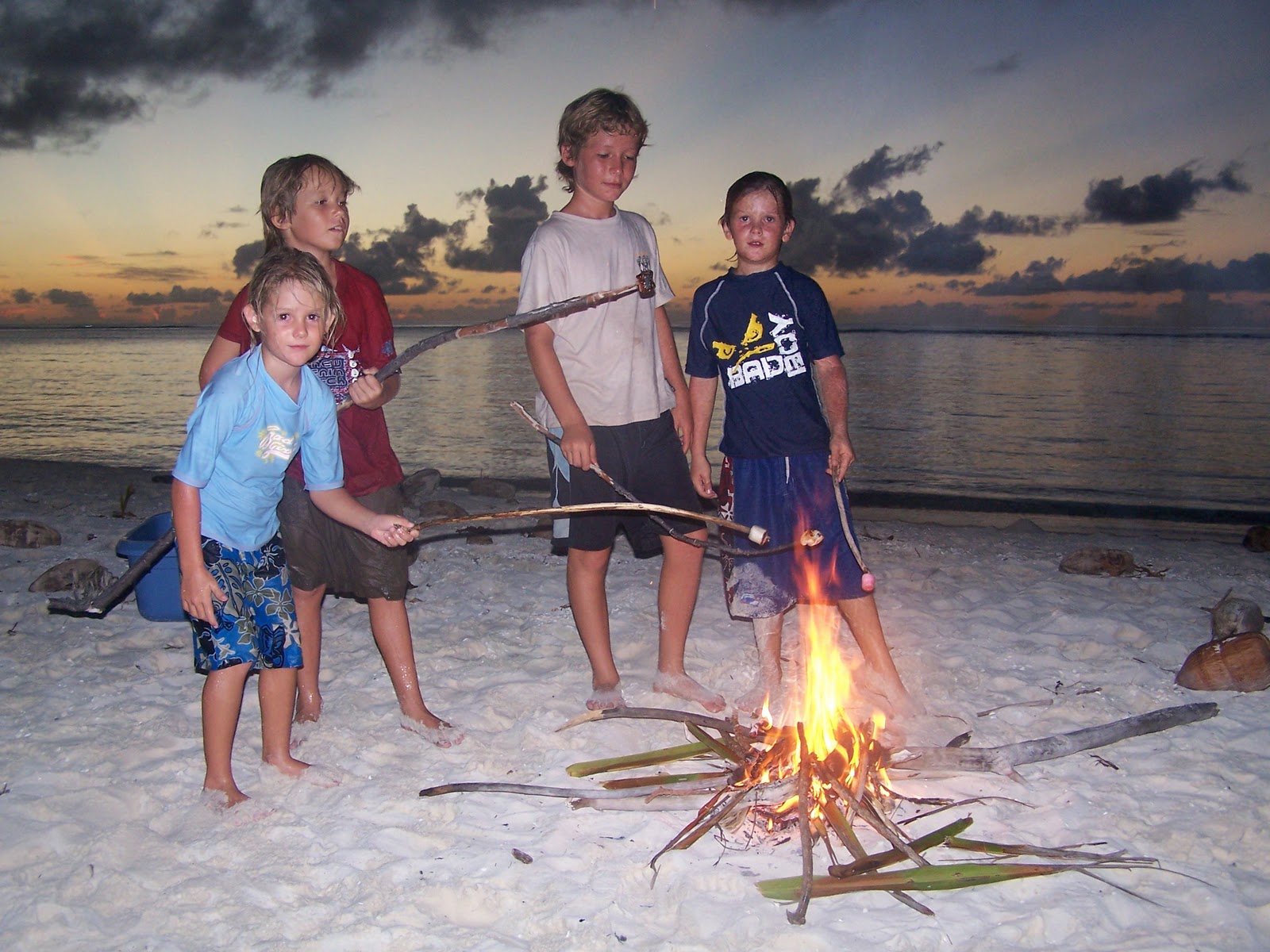
Kids braai-ing marsh mellows on Il Diamant


It was on the beach at Ile Diamant that Dan and Jenna introduced Manu and Tito to roasting marshmallows on the fire. The evening went on well into the night and we all had a most relaxing and memorable evening together.

The snorkeling was great off Diamant and the coral unspoilt with beautiful fan corals and plenty of reef fish. Unfortunately, some may say, there are lots of sharks! Black Tipped Reef Sharks are everywhere and were seen virtually every time we dived. They seemed more inquisitive than threatening and fortunately are not that big. The biggest we had seen so far was some 1 ½ meter or so.
The fishing off Diamant was fantastic. As I enjoy fly fishing, I spent most of my fishing day out throwing a fly. Success was varied and I must admit I lost a lot more than I caught, but catch I did and what a great way to catch a fish!! The fights I had were numerous and would make many a fisherman extremely jealous. And I suppose that is one of the many reasons why yachties make this journey to Chagos!

One afternoon Jean-Ives and I decided to go diving. We must have gone some 300 meters or so away from the yachts and for an hour or so we dived and spear fished. Little did we know but above us, the weather had changed rather suddenly. We were not aware of it as we hunted the waters for fish. Finally we decided it was time to head back to the yachts. The sea and wind had picked up and the ride back on the duck was bumpy.

When I got back to Shayile, I could see B was not happy. With the wind and seas having picked up, Shayile had dragged! We were on a lee shore and the reef came awfully close. The main problem was our awning which was up and acted as a huge sail, assisting in “pushing” Shayile towards the reef. Although shaken, B did extremely well and with the help of Christian, they had re-anchored Shayile. With the weather conditions, Christian upped anchor and headed off for another island which offered better protection. With me back on Shayile and Jean-Ives back on Erias, we both lifted our anchors and headed off after Christian.

We sailed in an easterly direction down towards an island called Ile Longue, with the wind still blowing 25 knots.


B: After a year of great excitement and many dangers, this was the most terrifying experience. I was down in the very forward cabin, turning and checking the potatoes for rotten ones when I realized that the awning was flapping harder than before. I went up to secure it and saw Erias come past me at a speed! We were DRAGGING!!

The reef loomed below the water and was coming closer all the time. I started the engines and tried to power forward, but had to leave the wheel to pull up the anchor chain to release the bridle, in order to let out more chain and halt the slid. I couldn’t drop the awning all the way as it covered the anchor chain and winch. Basically it was impossible to do it alone. We were veering wildly in the wind as I ran backwards and forwards and, because of a hardware problem, I was unable to find the centre of the steering. In desperation I blew the distress horn, hoping Rob would hear me and come back. The children were really scared and so was I! It was the first time I could see our boat being wrecked and our home destroyed. Nadine was unable to help as she had her hands full on Erias with high wind and scared children! Then Christian  arrived…..!! He had rowed over in his little dingy and popped his head up and said “Don’t worry, I am here” with the sweetest French accent I have every heard. He steered and fetched the scissors to cut the ropes holding the awning and I was able to stow it and pull up the anchor. We re-anchored in the same place and once I had caught my breath he shot off, pulled up his own anchor by hand, and sailed away. After he left I started to shake like mad and couldn’t stop the tears. I was so upset, the children were scared, and I was furious with Rob for going so far away to fish. We have always been a great team and I now knew how heavily we rely on each other, you cannot do this alone! Christian got a huge goodie bag from me the next day, including a whole slab of Cadbury’s chocolate, Rob was most unimpressed with the chocolate loss, but I reckon he earned it.


Picking coconuts


Ile Longue
When we got to Ile Longue, Christian was already anchored up. We dropped anchor close to him and we all sat out the afternoon waiting for the wind to die down. Although sheltered from the waves by the island, the wind was still howling.

We spent 4 days at Ile Longue and the fishing here was unreal. Again I spent most of my time fly fishing and again, though not always successful in landing them all, I did get some fine fish for the pan.

A creature that I found totally amazing on Chagos was the Coconut Crab. We had been told about them and read up a bit about them, but seeing one was special! The first time we came across one, I could not believe the size of it! These crabs are enormous! Apparently they can weigh anything up to 4kg’s! Their nippers are huge and the crab must be +2 feet in length. Coconut crabs, as their name describes, apparently live off coconuts. They rip open the coconuts and eat the flesh. We all know how hard a coconut is so you can imagine how powerful their nippers are! Avoid them! Unfortunately these crabs are quite rare and take many years to grow to full size. Some are reported to be as old as 35 years! Further to this, they are rather slow moving, easy to catch, and taste delicious. Many succumb to eager and hungry yachties.

Manu and Daniel with a Coconut Crab

One afternoon we had a great downpour of rain and managed to catch about 60 liters of water, the first time since arriving on Chagos. Not entirely successful, as our tanks were very low, but non the less it was some at add to the little water we had in the tanks

When it was finally time to up anchor, it was out of necessity to get water from one of the wells on the bigger islands.


Ile Grand Soeur
We left Ile Longue and set sail back to Ile Diamant. The wind was fair and, although squally, was allowing us to head in the right direction. We were also hoping for rain! Besides catching a great sized Rainbow Runner, I also caught a Shark! It took my lure which surprised me. These lures travel just below the surface and not easy for a shark to grab; or so I thought. It was a small Grey Shark (Nurse Shark) and after removing the hooks I let it go.

Slowly the wind picked up to 30knots and we were reefing the sails. We needed better protection than the island of Ile Diamant could offer so we angled in a SW direction and headed for Ile Grand Soeur. It was an exhilarating sail and the wind really pumped! It was a relief to be able to get into the lee of Ile Grand Soeur which offered us a bit of protection. We crept up the islands coast until we found a spot to anchor. Arias were not too far behind and they joined us, anchoring close by.
We spent another 3 days here and, again, the fishing was great! We lost a lot of fish and one day I was stripped by a fish, or something! It took off and would not stop. I had to apply pressure as I ran out of line before it finally parted. Some big GT I suspected!


Robinson Cruso kids!

B: Being deserted islands, surrounded by coral reef, you would imagine that the shells on the beach would be unbelievable. Think again. The shores are alive with hermit crabs of all sizes and shell shapes. Some out grow the large shells and have to fashion homes out of coconut shells. The strangest one was living in the bottom of a broken bottle. There were some beautiful long pointed ‘marlin spike’ shells but all of them were inhabited and I wouldn’t have the heart to evict the cute little crabs who live inside them. The only shells that escape being squatted in were the cowries and cone shells. As I spent many happy hours with my family, Aunt and Uncle and cousins searching the Natal coast for cowries this suited me fine. We found lots of Money; Gold ringer; Arabian; Carnelian; Map; Arabian; Serpents Head  and Tiger cowries but mostly small to medium sized. The only large shiny Tiger cowrie I found was lying all alone on a shell-less beach where we spent one hour before an oncoming storm sent us scuttling back to the boat. On the way back we had to take evasive action to avoid hitting a drowsy turtle grazing over the reef.
It was now time to move again as we needed water desperately. We also wanted to explore what may be termed the main island in Paros; Ile Du Coin.
We upped anchor and sailed a short distance in a southerly direction towards Ile Du Coin.

Ile Du Coin 
Back in the days when Chagos was inhabited, Ile Du Coin was the hub of Peros Bahnos. It was here that the village was situated. As we approached, there were 2 other yachts anchored off what appeared to be a pier. We found ourselves a piece of sand amongst the coral and dropped the anchor. As water was high on the list of priorities, we went ashore to check out the well that was situated in the remains of the village. After beaching the ducky and wandered into the coconut trees and soon found the well which was positioned next to a derelict house. The house, a double story wooden house of sort, belonged to the governor of the island years back. Unfortunately it was falling apart quite badly and kind of tricky even to enter and explore! We took our jerry cans and began to fill. No sooner had we started to fill the cans, the mosquitoes arrived in their squadrons, so much so that we had to leave in a hurry.

Next day I was back at the well, armed with plenty of Mozzie repellent and long pants.

I filled our containers and headed back to Shayile. As the water was not recommended to drink, I had to filter it. As our water maker on board Shayile was pretty much dead, I rigged up hosepipes and managed to use the water makers 3 part filter system to filter our water. We then added a few purification tablets to the tank and in went the water. A few loads and we had our tanks half full. We were still optimistic that it would rain. Ha ha!


Tito and Daniel           

One morning, we all went ashore to collect some washing up water. Daniel and Jenna played on the beach whilst B and I went to the well. As we were filling up we heard a chilling scream coming from the beach. Not knowing who it was, I sprinted off towards the beach. Jenna was running towards us screaming “Daniel had fallen out a tree”. It was not far and I arrived to find Daniel lying on some very nasty rocks. He had fallen out of a coconut tree onto the rocks. (The rocks formed part of the old jetty and pretty much the only rocks around! He was crying and looked terrible. He was bleeding from a gash on the head and there was blood in his ear. I asked him where it hurt and carefully lifted him up; concerned that he may have hurt his back. Fortunately it was ok. B arrived and we lay him down on the beach. Between breaths he was saying “Sorry” and “This is like a nightmare but it’s real!!” He really was in a bad way. We cleaned him up and examined the damage. A gash on the head, swollen elbow and wrist, a big scratch and early bruising low on his back. We took him back to Shayile and got busy with the first aid kit. To say he was extremely lucky is downplaying this fall. It must have been a good 2 ½ meters that he fell and how there was no broken arms or serious damage, I have no idea.
He perked up but we could see he would have bruises and pain for some time to come.

Next day, we decided to sail across to the island of Ile Fouquet and catch up with Belagear and Ad Astra. I needed some glue for the rubber duck which was slowly coming apart at the seams and continually leaking air. Peter said he could assist me with some as our poor rubber duck was now in a bad way!

Off we sailed to Ile Fouquet, a short distance of some 3 miles.


Ile Fouquet

As we approached Ile Fouquet, we counted some 7 yachts there. It appeared to be a great anchorage and the waters were very calm. We sailed passed Ad Astra waving to Ian and Elizabeth. We had not seen them since Dar and that was only for an hour or 2. We had spent time with them on Sakatia in Madagascar. We then sailed passed and greeted Kim and Sinead on Rival Chief, having last seen them in Dar as well. We found a sandy patch close to Belagaer and dropped anchor. It was great to see some familiar faces again!

We spend 4 days or so at Ile Fouquet and it was fantastic to get into the company of a group of yachts again. We loved being alone, sailing and traveling as a family, but it was also great to socialize with other yachties from time to time, catching up on news and stories.

That first evening we were invited ashore for a fish smoking evening. (Getting the fish to stay in the rizzler is quite difficult – only joking!) Ian on Ad Astra had a smoker so those with fish took it along and it was smoked to perfection. We were introduced to the other yachties and spent the evening catching up on everyone’s news.

The next evening was a Pot Luck dinner and everyone brought something along to eat. It was spread out and a fine dinner of assorted food from different yachts was eaten!

Hunting kids


B: As rather new arrivals, and with a freezer, I was able to treat everyone to a change from the fish diet with a home-made chicken liver pate. Well that went down well, especially when you realize that some folks live without fridges, never mind freezers. I even had a marriage proposal; clearly Günter had had enough of fish!!


The camp where the socials took place was great. No mozzies and well protected amongst the coconut trees. It was great to be able to catch up with people we had met at previous destinations, exchanging stories on our travels. We also met other yachties most of which had sailed in from the East. (Thailand and Malaysia)
I was planning on repairing the ducky, but as it happens, we just never got around to it. Too much fishing and “other things” to do.


Rob with a sundowner


One morning, we heard via Peter on Belagaer that strong westerly winds were predicted and that he and a few other yachts were leaving to go to the Salomon atoll. We decided to stay on a while longer as we were enjoying Peros Bahnos and wanted a few more days to explore the islands further.

With 3 or 4 yachts heading off, we returned to Ile Du Coin, back to where Erias was anchored to spend a few more days there. We lifted our anchor and motor sailed back to Ile Du Coin.


As mentioned Ile Du Coin was a great island to explore. With its many houses and derelict infrastructure, it was worth checking out. Further more there was reported to be, some elusive fruit trees tucked away amongst the trees.

We dropped anchor next to Erias and Yacht Mariposa, an American yacht, who was now anchored along side Erias. There were also 1 or 2 other yachts there at the time.

Govenors house on Ile de Coin

More ruins


One afternoon, the Shayile and Erias crew went on a food search. First place we came across was the village cemetery. It was quite eerie but interesting to see dates and names on the many broken and destroyed tombstones. Most of them were in French which was rather surprising. We were not aware that French was the language spoken by the island residents. Many of the graves were children, a clear indication of the harsh environment they were living in. From the cemetery we bashed our way through the vegetation and coconut trees, again looking for those elusive orange trees.

After about an hour we found them and managed to get about 10 or 15 oranges. We also found a few lemon trees but, unfortunately, no lemons. Finally we came across the last remaining residents on Ile Du Coin, a few donkeys! They looked pretty healthy and obviously had access to a stable diet.

Our food search continued and next up was Bread Fruit Tree. For those of you who do not know what they are, (I had no clue) they resemble a green melon. They grow on trees and are not easy to pick! Their flesh is unique. Hard almost potato textured when green, but turns into a sweet, soft, almost paw-paw fleshed when ripe.


Graveyard on Ile du Coin

After a succession of attempts at getting to the Bread Fruit, which had us all in hysterics, I finally managed to scramble up the tree with the help of a rope. With a gaff tied to a paddle, I managed to get 5 bread fruit down. A successful food gathering afternoon was had.

The next afternoon the Shayile and Erias teams went ashore for a beach braai. The kids and I collected wood and made a “camp”. We the prepared a fire and, as the sun was setting, we fired it up.

Now a beach braai sounds a lot more romantic and exciting then it actually is.  Without charcoal, fires for a braai are a mission; it’s dark and the meat tends to be grilled on one side and raw on the other; and, no matter how careful you are, there is always a dose of beach sand on the meat! Trying to lay all the food out, without a salad landing upside down in the sand, is an art! However we did it and we all had a very successful braai and a wonderful evening on the beach.
When the braai was over we filled the fire with wood and all sat around and enjoyed the company and unique surroundings. The kids played around the fire way into the night. As their batteries started to run low, we packed up and headed back to the yachts.

That night we decided it was now time to sail across to Salomon. The plan was to leave first light next day.
This we did and next morning, we upped anchor and headed across the atoll towards Ile Fouquet, and out through the pass on the southern side of Peros Banhos.


It was a pleasant crossing with the wind almost directly behind us and not much of a swell. The distance was 25 miles and it lies virtually due east of Peros. We all sat back and enjoyed the short crossing to Salomon!